
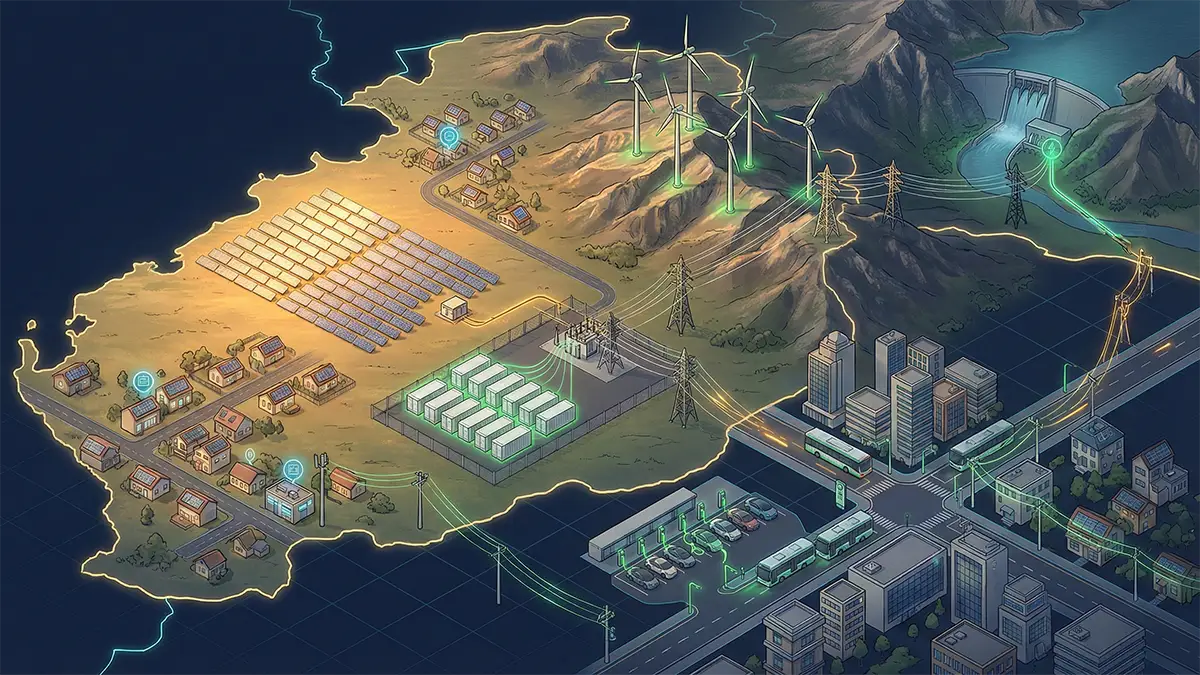
Albania’s National Energy and Climate Plan (NECP) sets a practical goal for 2030: to maintain the country’s clean hydropower core, add significant amounts of solar and wind energy, develop smart grid’s, and expand electric transport, ensuring the lights stay on in both wet and dry years. Hydropower gives Albania low emissions today, but dry seasons create risk. The plan reduces that risk by diversifying the electricity mix and improving system flexibility.
What’s in the pipeline
- Competitive auctions: to bring in large volumes of solar and wind, with Contracts for Difference (CfD) as Albania’s day-ahead power market matures.
- Distribution losses: targeted to be cut in half compared with the mid-2010s, paired with smart metering and grid digitalization.
- Electric vehicles: entering policy mainstream, with tax incentives and a planned nationwide charging network
- Storage (batteries + demand response): moving from concept to policy
New solar and wind plants will be built through competitive auctions. By 2030, Albania expects utility-scale solar photovoltaic power of roughly 240 to 600 MW and utility-scale wind of about 220 to 520 MW, plus around 40 MW of small hydropower and 100 MW of small-scale PV on homes and businesses. Auctions will be conducted using fair and transparent rules, allowing investors to plan effectively. As the market matures, long-term power purchase agreements (PPAs) can shift to contracts for difference (CfD) or contracts for premium (CfP) to reduce revenue risk.
People and energy communities will take part directly. Under Law 24/2023, households, small firms, and public bodies can become “prosumers,” which means they both produce and use electricity, usually with rooftop PV. Systems with a capacity of up to 500 kW are permitted, featuring straightforward connection procedures and transparent settlement rules. Over time, billing can transition from classic net metering to net billing, which better aligns with actual costs and supports local energy sharing and aggregators that coordinate multiple small systems.
Grids will be upgraded and digitized to carry more clean power. On the transmission side, high-voltage links such as the 400 kV Albania–Kosovo interconnection and the 400 kV Bitola (North Macedonia)–Elbasan (Albania) line will strengthen regional trade and balancing. On the distribution side, losses are expected to decrease to approximately 12% by 2030, thanks to refurbishment and the implementation of smart meters that accurately record usage and support modern tariffs. The smart-meter rollout will begin with medium-voltage users and transformers, and then expand to low-voltage customers, focusing initially on areas with high energy losses.
Electric mobility will grow in a measured way. The plan introduces tax incentives for electric vehicles (EVs), including a value-added tax (VAT) exemption on new EVs, zero first-registration fees, and multi-year road tax holidays. A national charging network will be built, and cities such as Tirana are already piloting public chargers and low-emission buses. The country’s target is to have about one in ten cars be electric by 2030, with a few hundred public chargers in place.
Storage and demand flexibility will support reliability. Batteries will store daytime solar and help manage the sharp rise in evening demand, while demand response (shifting some use to different hours) will reduce peaks and avoid waste. The plan envisions an auction for storage capacity on the enhanced pathway, which would establish clear rules for determining the required megawatts and megawatt-hours, as well as the payment for fast-response services.
Clean heating is part of the transition. Heat pumps, which transfer heat instead of burning fuel, are expected to capture a growing share of home heating, particularly as buildings undergo renovation. Pairing rooftop PV with heat pumps can lower energy bills and reduce winter peak demand. To scale this, the plan points to practical tools such as boiler replacement schemes, municipal retrofits managed by energy performance contracts, and tariffs that reward efficient electrification without overloading local lines.
The plan also identifies key risks and outlines strategies for managing them. Dry years will still happen, so the system must rely on a balanced mix of hydropower, solar, wind, storage, and strong cross-border lines. Permits and grid connections can slow projects, so Albania will utilize a digital one-stop shop, standard contracts, and public maps to show the capacity each feeder can accommodate. Large wind projects and new transmission lines require early and open engagement with communities to build trust and share benefits.
In short, Albania’s path to 2030 is clear. Keep hydropower strong by adding solar and wind through steady auctions. Modernize the grids with smart meters and new interconnectors, grow EV charging infrastructure, and build storage and demand flexibility. If institutions and investors deliver on time, Albania will have cleaner, more reliable, and more affordable electricity in every kind of year.