
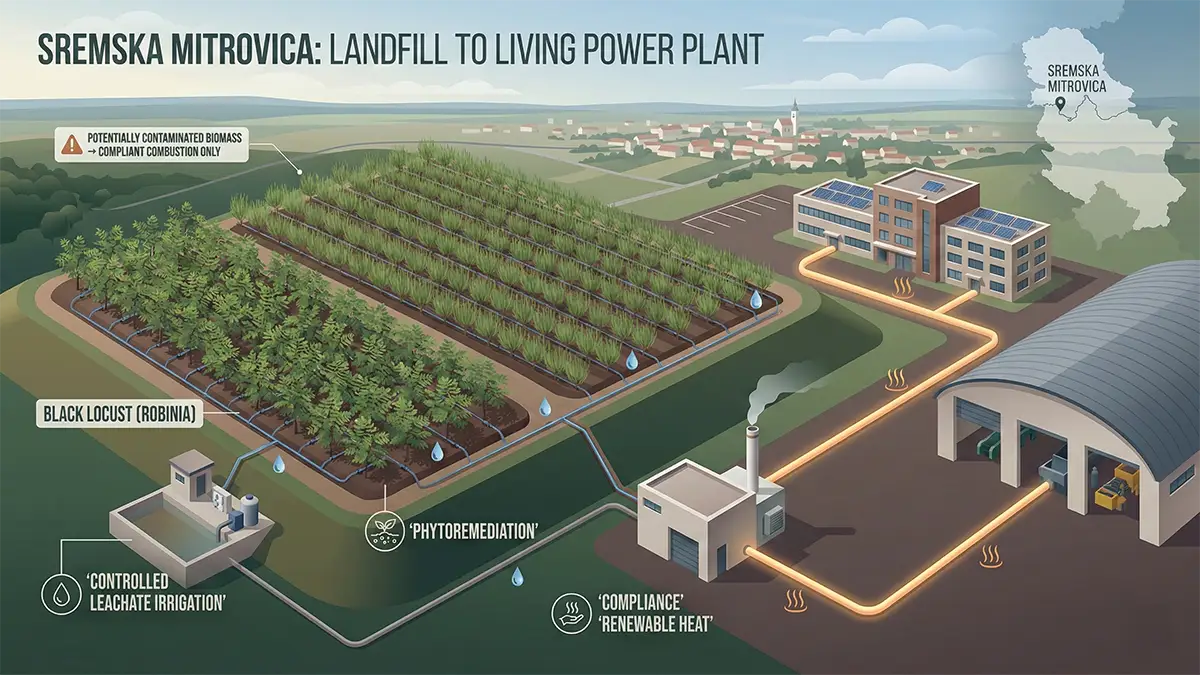
Serbia faces the dual challenge of remediating legacy waste sites and cutting fossil heat. Converting capped landfill areas into short-rotation energy plantations delivers both: phytoremediation, leachate management, and renewable heat that eases pressure on natural forests while creating local jobs. At Srem-Mačva (Sremska Mitrovica), a 6.7-hectare pilot shows how to align engineering, compliance, and economics into a bankable, community-scale solution.
A practical, replicable model to reclaim a closed landfill with short-rotation willow and black locust, clean leachate via controlled irrigation, and produce renewable heat in WID/IED-compliant boilers. Learn the design, economics, governance, and rollout steps to scale landfill-to-energy crops across Serbia.
Project at a Glance (Srem-Mačva)
- Total area: 6.7 ha (≈ 5.7 ha willow on capped cell + 1.0 ha black locust off-cell)
- Core functions: Controlled leachate irrigation, phytoremediation, biomass fuel for renewable heat
- Key constraint: Potential contamination of willow biomass harvested on the capped cell
- Compliance path: WID/IED-compliant boilers (regulated combustion + flue-gas cleaning) or on-site municipal heat plant
- Economic hinge: Irrigation strategy—the make-or-break lever for NPV and bankability
How the Design Works
Species & Site Design
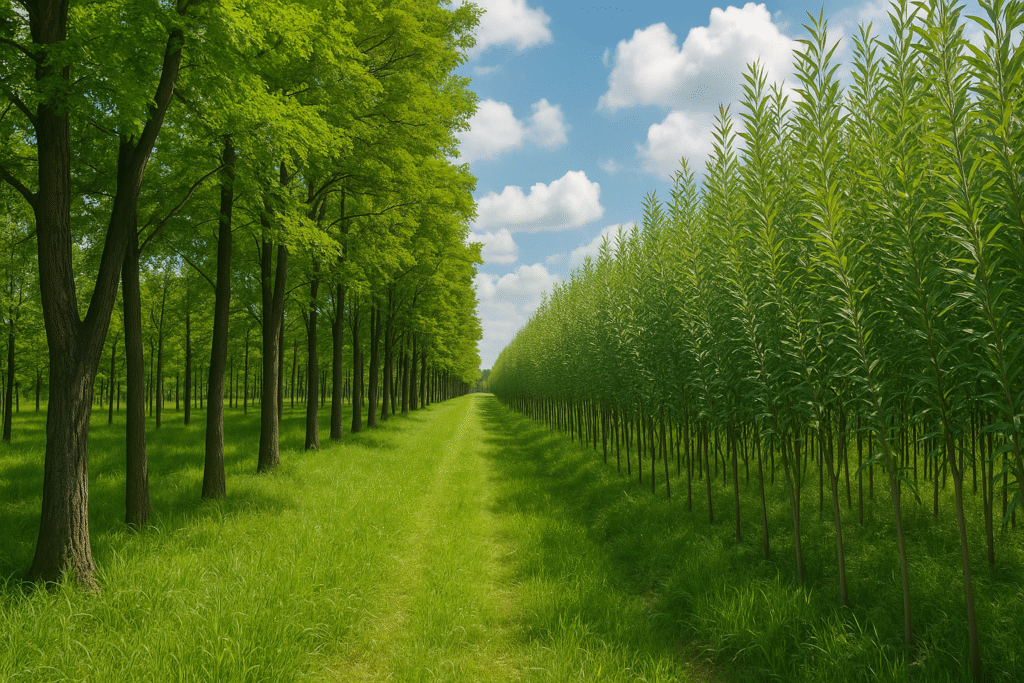
- Willow (Salix spp.) on the capped waste cell for fast growth and strong phytoremediation response; accepts drip-fed leachate as an irrigation source under monitored regimes.
- Black locust (Robinia pseudoacacia) on ~1 ha for robustness, nitrogen fixation, and diversified yields.
Leachate-Supported Irrigation
A controlled drip irrigation system distributes leachate at agronomic rates, accelerating biomass growth while aiding soil-health improvements. This creates a closed-loop: the landfill supports the plantation; the plantation yields fuel to offset fossil heat on site.
Economics: Irrigation Is the Decisive Variable
- Reference drip cost: ~€4,000/ha
- Willow area (5.7 ha): ~€57,000 initial capex just for drip, dominating upfront spend
At a 6.8% discount rate, modeling with full drip coverage yields negative NPV across cases at reference biomass prices. Conclusion: Irrigation capex—more than yields or prices—determines feasibility. A lean-capex irrigation variant (prioritizing zones, staging, simplified hardware, or mixed sources) is necessary to flip NPV positive.
Compliance & Offtake: Safe, Legal, Bankable
Because willow is grown on a capped waste cell, harvested biomass must be treated as potentially contaminated. That rules out retailing to households and points to:
- WID/IED-compliant boilers (higher-temperature, regulated combustion, flue-gas cleaning), or
- A municipal heat plant with appropriate emissions controls.
On-site use is strategically preferred: install a compliant biomass boiler at the landfill to heat depot offices, a 3,000 m² recycling hall, and the Center for Sustainable Development—fueled by a blend of plantation chips and contaminated wood waste otherwise headed to landfill. This internalizes compliance, cuts logistics, and stabilizes revenues.
Business Model & Revenue Stack
Core Revenue & Savings
- Heat sales/savings from the on-site WID/IED-compliant boiler (displacing LPG/FO/heavy fuel or electricity for heat)
- Gate-fee value from diverting contaminated wood waste into compliant combustion
- Operational savings from reduced leachate handling (where applicable)
Support Mechanisms
- Provincial forestry subsidies for energy plantations
- Potential circular-economy or just-transition grant windows
- Long-term O&M contracts with public utility to de-risk performance
NPV Sensitivities to Track
- Irrigation capex (coverage, staging, tech choice)
- Heat tariff (or avoided-cost benchmark) and load factor of site buildings
- Biomass yield & moisture (affects boiler efficiency and O&M)
- Subsidy intensity and timing
Governance & Delivery
- Planting & upkeep: Contract experienced forestry specialists (e.g., Vojvodinašume).
- Owner’s team: Appoint a utility-side coordinator for procurement, monitoring, and reporting.
- Research partners: Formal MoUs with the Faculty of Sciences (Novi Sad) and Institute of Lowland Forestry to monitor irrigation regimes, leachate handling, soil health, and phytoremediation outcomes—turning the site into a living laboratory.
Environmental & Social Benefits
- Phytoremediation & leachate treatment integrated with growth cycles
- Renewable heat that reduces fossil use and avoids landfill emissions
- Pressure relief on natural forests through plantation supply
- Rural jobs and municipal income from a new, circular value chain
Risks & Mitigations
- Compliance risk: Stick to WID/IED-compliant end-use; maintain rigorous monitoring & record-keeping.
- Market risk: On-site heat use and public-sector off-take minimize pricing volatility.
- Yield risk: Use resilient clones, phased replanting, and adaptive irrigation.
- Capex risk: Adopt the low-capex irrigation variant and stage investments to production milestones.
Replication Potential Across Serbia
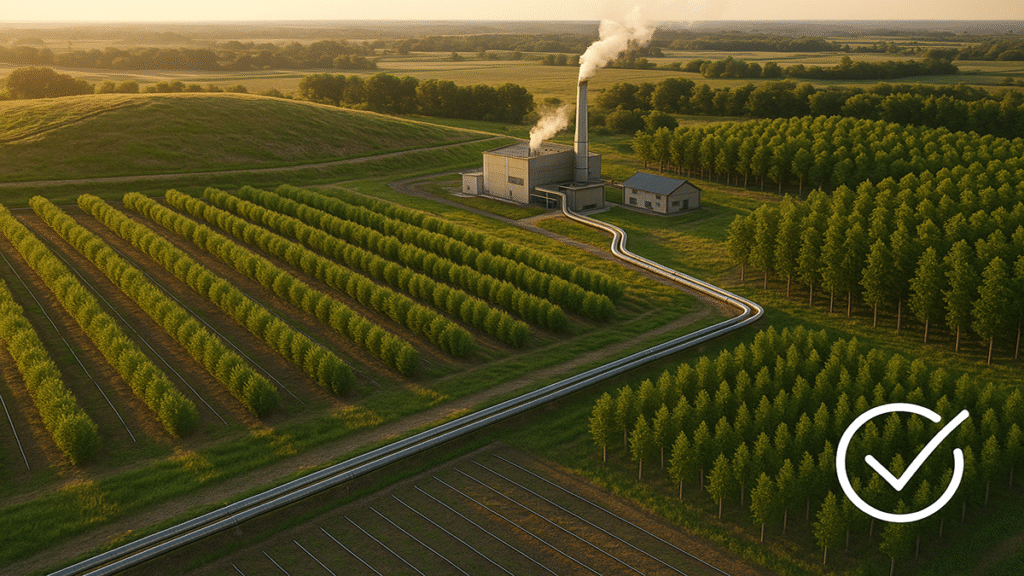
Executed correctly, Srem-Mačva becomes Serbia’s reference model: a closed landfill that cleans its legacy, heats its own facilities, and proves a scalable pathway for circular, local-energy transitions. Start lean on irrigation, secure compliant on-site heat offtake, embed research & monitoring, and publish results—so other municipalities can replicate with confidence.
The Srem-Mačva model is replicable on capped landfills, ash-disposal areas, and former open pits. The formula—lean irrigation, compliant end-use, monitored remediation—can scale to thousands of hectares, with public support justified where private returns are thin but social and environmental returns are strong.
FAQ
Why short-rotation willow and black locust?
Willow excels at phytoremediation and rapid biomass; black locust adds nitrogen fixation and resilience—together delivering yield, soil benefits, and operational redundancy.
Can households use the chips?
Not from the capped cell area. Treat biomass as potentially contaminated; use only in WID/IED-compliant boilers or municipal heat plants with proper flue-gas cleaning.
What if irrigation is too expensive?
Adopt the low-capex irrigation variant (staged deployment, targeted zones, simplified hardware). This is the fastest lever to move NPV from negative to positive.