
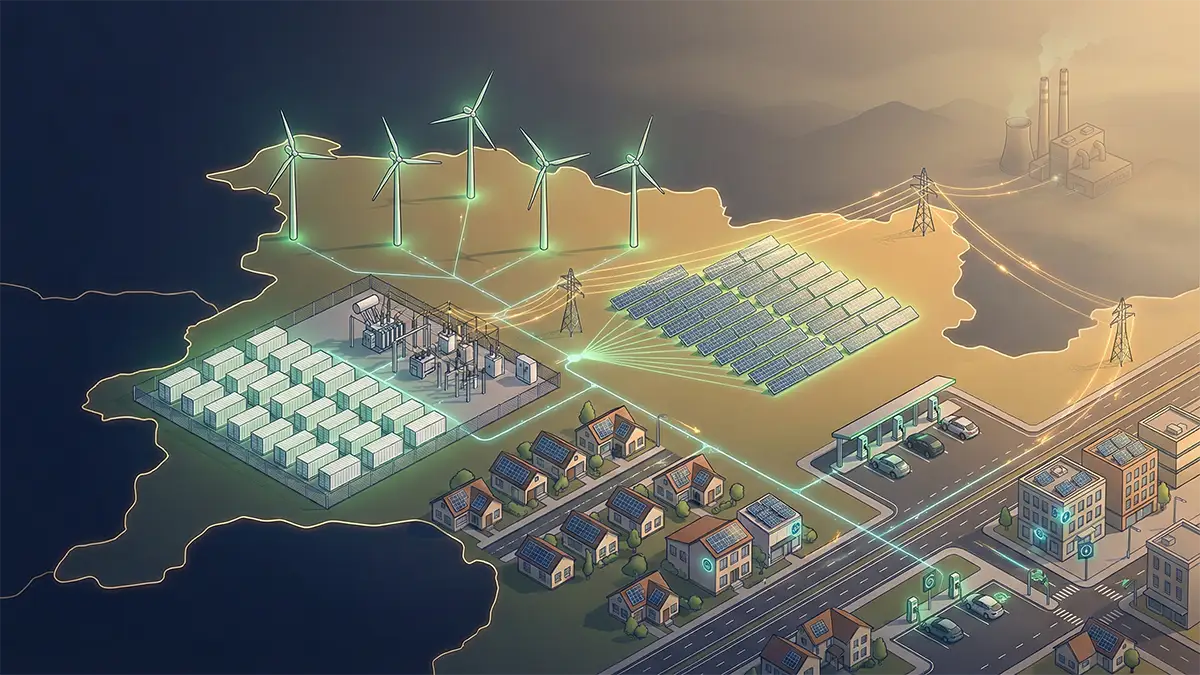
Kosovo’s National Energy and Climate Plan (NECP) outlines the country’s vision for its electricity system by 2030. The goal is to keep the lights on, cut pollution, open the market, and protect households and industry from high costs. The plan is credible, but it requires fast and careful execution.
What’s in the pipeline
- Core shift: add large volumes of wind and solar (≈600 MW wind + 700 MW PV by 2031), backed by 170 MW battery storage and upgraded grids.
- Security anchor: lignite remains the reliability backbone this decade, but with Kosova A partly retired (one unit decommissioned by 2031) and moved to strategic reserve after 2028.
- Market reform: full ALPEX coupling with Albania and broader regional integration to improve price signals and trading liquidity.
- Customer focus: time-of-use/dynamic tariffs plus smart meters to activate demand response, prosumers, and EV charging.
New clean power will be added incrementally. By around 2031, Kosovo is expected to have approximately 600 MW of wind power and around 700 MW of solar photovoltaic power (PV). A battery program of roughly 170 MW will store energy and help maintain grid stability. These additions make variable renewable energy (VRE) more reliable.
Coal use will decline, but it will still help with the security of supply during this decade. The lignite-fired plant Kosova B will remain essential for reliability. The older Kosova A plant will operate less, be moved into a strategic reserve after 2028, and have one unit of approximately 116 MW retired by 2031. A strategic reserve means the plant is kept ready for emergencies but does not operate every day.
Market rules will improve through market coupling. Kosovo plans to achieve full trading integration with the Albanian Power Exchange (ALPEX) and establish deeper regional links, ensuring that prices and trades reflect real supply and demand. Better markets provide clearer price signals and increased liquidity, which benefits investors and reduces costs.
The power grids must be upgraded to handle these changes. The transmission system operator, KOSTT (TSO), will increase hosting capacity for VRE from approximately 500 MW in 2024 to around 2,000 MW by 2031. Interconnections with neighbors already meet European benchmarks; the next step is to utilize them more innovatively through improved capacity calculation and congestion management. The distribution company KEDS (DSO) will reinforce medium-voltage and low-voltage networks, reduce losses to about 9%, and deploy modern tools such as SCADA/DMS (supervisory control and data acquisition/distribution management system) and smart meters. These upgrades make room for prosumers, batteries, and fair time-based tariffs.
Prices will help guide behavior. Time-of-use and dynamic tariffs (prices that change by hour to reflect system conditions) will encourage people to charge electric vehicles (EVs) and run appliances when power is cheaper and cleaner. Smart meters accurately measure use and enable demand response, allowing for the shifting of some use to off-peak hours to reduce stress on the grid.
People and communities will play an active role. Prosumers (users who both produce and consume electricity, usually with solar rooftop PV) are expected to reach at least 30 MW by 2025 and at least 100 MW by 2031. The policy employs net billing (paying for exports and imports separately) with simple, stable formulas and standardized grid connections. Energy communities, where neighbors plan and share projects, will have easier permitting and can help fund local feeders or storage, which reduces bottlenecks.
Transport will get cleaner in a practical way. By 2030, at least 10% of vehicles should use alternative fuels, including EVs. New chargers will initially be located along main corridors and in city hubs, and charging will be linked to dynamic pricing, allowing it to occur when the grid can best support it. The rail sector also plans higher electrification through 2030.
Some risks must be managed. Permits for land and the environment can be time-consuming, so a digital one-stop shop and pre-screened zones can expedite projects. Grid connection queues can become congested, so public maps showing hosting capacity will help developers plan. Market rules must be clear on how curtailment (temporary shutdowns of wind or solar) and imbalances are handled, or capital costs will rise. The coal transition requires a just transition program to support workers and communities.
In short, Kosovo’s plan is to scale up wind and solar, keep reliability with targeted coal down-ramping and new storage, modernize the grids, and make prices reflect the real-time value of electricity. Success depends on three levers: bankable auctions that attract investment, grid readiness across transmission and distribution, and dynamic tariffs supported by smart meters. If these levers are delivered, Kosovo can have a cleaner, more reliable, and affordable electricity system by 2030.