
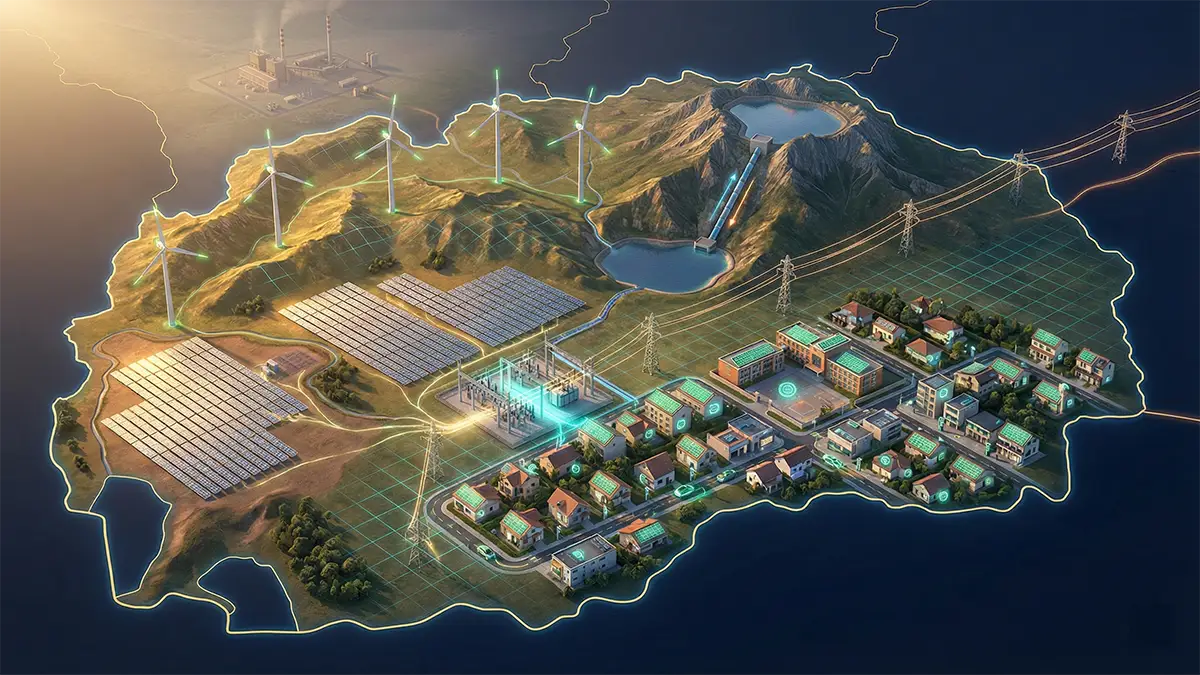
North Macedonia’s National Energy and Climate Plan (NECP) sets a straightforward goal for 2030. The country will close old coal plants, build more solar and wind power facilities, add storage to balance the system, and modernize its electricity networks so they function like a true strategic asset.
What’s in the pipeline
- Utility-scale solar and wind via auctions.
- Rooftop PV and prosumers driving local generation (≈250 MW by 2030).
- Chebren pumped-storage to firm variable output (planned in service before decade’s end).
- Digitalized grids, smart meters, and real-time price signals to unlock demand response.
- A just transition that manages coal closures and repurposes sites for PV.
New renewable power will come from large solar and wind plants built through auctions. Rooftop solar photovoltaic panels (PV) will spread across homes and businesses and are expected to reach about 250 MW by 2030. Older coal sites, such as Oslomej, are already being converted into solar fields, and wind power – around 600 MW in indicative plans – will help mitigate seasonal changes in supply.
The system needs flexibility so electricity is available when people need it most. The Chebren pumped-storage hydropower project is the flagship of its kind. The plan also utilizes demand response (DR), which involves shifting some electricity use to different hours, as well as independent aggregators that coordinate many small users. Additionally, it employs real-time tariffs, allowing prices to guide when people charge cars or run appliances. If the storage schedule slips, a small gas plant can serve as a temporary bridge to maintain grid reliability.
The electricity networks must be ready for this change. On the distribution grid, smart meters and remote control will be rolled out, resulting in a reduction in grid losses from approximately 12% to 8%. These steps create space for more rooftop solar PV and for charging electric vehicles (EVs). On the transmission grid, the new 400 kV link between Bitola and Elbasan will enhance trade and balancing with neighboring countries.
People and communities will play an active role. Prosumers, who both produce and consume electricity with rooftop solar PV, are central to meeting the rooftop goal. The plan also supports “smart communities,” such as campuses or neighborhoods, where local generation and flexible use are coordinated to lower costs and help the grid.
Clean heating is part of the solution. Heat pumps, which move heat instead of burning fuel, will be supported with funding and standards. Pairing heat pumps with daytime solar reduces winter peaks and cuts the need for gas or biomass.
Transport will transition to a more electric system in a managed manner. The plan envisions funding public and private charging, updating tariffs so that EVs charge when electricity is both cheapest and cleanest, and exploring vehicle-to-grid (V2G) technology through aggregator programs, which involves sending small amounts of power back from parked EVs to the grid. The focus is not on a single number of chargers, but on making EV charging a flexible and helpful load rather than a strain.
Coal is on a clear exit path. Oslomej is considered retired, and Bitola is expected to close around the middle of the decade, with a just transition program that retrain workers, repurpose land for PV, and support local budgets.
There are risks that need careful management. The schedule for pumped-storage must be realistic; if it is delayed, demand response and battery tenders should scale up quickly to compensate. Distribution companies require predictable funding to install smart meters and automation systems. Permitting and grid-connection queues must be transparent and based on clear data and deadlines. Tariff design should provide real-time or time-of-use price signals so EVs, heat pumps, and industry shift use to low-cost hours.
In summary, the NECP offers a workable plan: build renewables, secure flexibility, modernize grids, and electrify heat and transport. Delivering these four pillars with discipline will give North Macedonia cleaner, cheaper, and more reliable electricity, which strengthens the economy for the long term.