
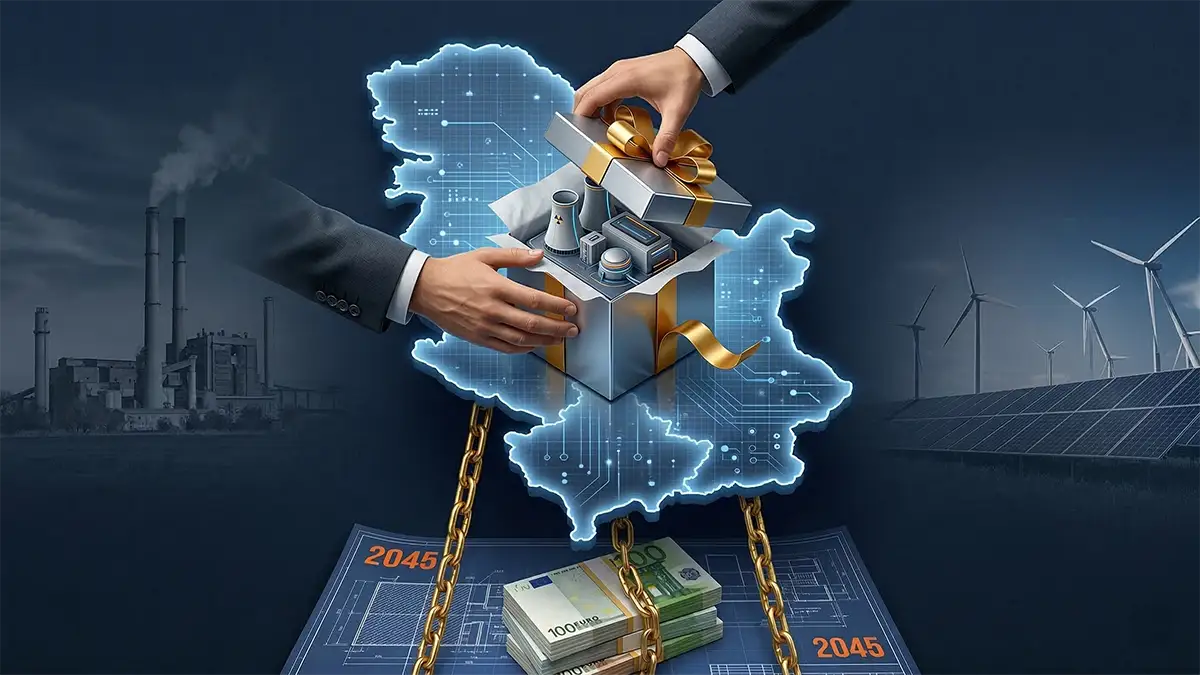
Serbia is seriously looking for a way out of its energy dependence on coal, and this is an undeniably legitimate and urgent issue, especially given that around 70% of electricity generation remains tied to coal and that decarbonization targets have been set for 2050.In response, the Ministry of Mining and Energy commissioned the “Preliminary Technical Study for Considering the Peaceful Use of Nuclear Energy in the Republic of Serbia,” the results of which were recently presented to the public.
The problem arises when such a major strategic decision is presented as an almost natural technical step, even though the study itself is full of caveats, assumptions, and data gaps.
The study was commissioned by Serbia’s Ministry of Mining and Energy and prepared by EDF and Egis, and it is especially important to note that EDF is one of the world’s largest nuclear operators and a company with a clear business interest in expanding nuclear capacity. This does not automatically mean that all of its findings are wrong, but it does mean that the document should not be read as a neutral roadmap; rather, it should be understood as an analysis prepared by an actor with a direct interest in opening the political and institutional space for the nuclear option.
Where the Study Seems Convincing
The strongest part of the document is its diagnosis of the problem: Serbia cannot remain reliant on lignite in the long term, and the energy transition will require big changes in generation, the grid, institutions, and human resources. The study relies on the IAEA Milestones approach and offers a three-phase framework, from initial analysis and political positioning, through infrastructure development and site characterization, to construction and commissioning.
This part appears serious because it shows that the nuclear option is not “one investment,” but a long-term state project requiring a regulator, a legislative framework, an education system, a safety architecture, and long-term financial discipline. In other words, the study usefully reminds us that the question of a nuclear power plant in Serbia is less a question of technology and more a question of the state’s ability to carry out a complex and costly institutional undertaking.
Where the Problem Begins
The biggest weakness of the document is not that it advocates nuclear energy, but that it does not give alternatives genuinely equal treatment. In the modeled scenarios, what is varied in practice is the number and type of nuclear units, while there is no serious comparative scenario in which Serbia would compare the nuclear pathway with a combination of renewable energy sources, modernized hydropower capacity, energy storage, and demand-side management.
This is a key methodological flaw because it assumes in advance that nuclear energy is almost necessary as a replacement for coal-based baseload generation. Once the problem is framed in that way, the nuclear option is no longer one choice among several, but a conclusion partly built into the question itself.
An additional problem is the way the study treats the public. Instead of recognizing resistance to nuclear energy as a legitimate political and social dilemma, the document largely presents it as a challenge to be addressed through information campaigns and acceptance management. That tone sounds more like a communication strategy for implementing a project than an open discussion about whether the project is truly the best choice for society.
Technological Limitations
The study’s recommended technological framework is also particularly interesting. The document limits its assessment to large Generation III/III+ reactors and small modular reactors (SMRs) within the same development logic, while Generation IV is practically excluded from serious consideration.
Formally, that choice can be defended on the grounds of technological maturity, since III/III+ technologies are treated as more commercially available and more clearly regulated options. But strategically, there is a serious dilemma here: if Serbia is only now entering the nuclear cycle and the actual deployment of its first capacities belongs to a much longer time horizon anyway (around 2045), then choosing today’s “proven” technology may also mean locking into a platform that could already be technologically outdated by the time it becomes operational. In other words, the study seems to assume that a conservative technological choice is automatically the best strategic choice as well, even though a country starting from scratch should be especially careful to consider the risk of long-term technological lag.
An Economy on Shaky Ground
The most serious objection concerns the modeling of the regional energy environment for 2045. The document acknowledges that a 2045 projection was used for Serbia, while neighboring countries were modeled using 2034 data, which is why the results regarding electricity imports and exports should be interpreted with caution.
This is not a minor footnote, but a direct blow to the core of the economic argument, especially for scenarios involving large 2×1200 MW reactors, where the possibility of Serbia becoming a net exporter of electricity is presented as an important outcome. If the regional export market is based on outdated assumptions, then the claim of the economic viability of large-scale capacity becomes highly problematic as well.
In other words, Serbia could end up building expensive generation capacity for a market that by 2045 may no longer look anything like what the study assumes. If neighboring countries, meanwhile, develop their own nuclear capacities (Hungary, Romania?), large-scale renewables, or energy storage, Serbia’s planned electricity surplus could easily become a financial burden rather than a strategic advantage.
Large nuclear reactors require a utilization rate above 90% in order to be economical. If there are not enough buyers for their output, these multi-billion-euro investments become stranded assets.
The way the study treats the cost of generated electricity is also important. The study explicitly states that energy scenarios should not be compared solely on the basis of the levelized cost of electricity (LCOE), but more broadly through the lens of sovereignty, resilience, and systemic benefits. In principle, that is reasonable, because LCOE does not capture all grid and strategic effects.
But the problem arises when that argument is used to bypass the most uncomfortable question: whether the nuclear option, with capital investments of several billion euros, long timelines, and the risk of delays, is economically competitive with combinations of renewables, storage, and system flexibility. If LCOE is relativized without offering an equally rigorous and transparent alternative for comparing total system costs, then the expensive nuclear option is presented as “strategically rational” without a solid economic argument.
Between Sovereignty and Dependence
The study strongly insists on concepts such as energy sovereignty, resilience, and the state’s strategic positioning. These are legitimate goals, but in this document, they also partly serve to shift attention away from a more uncomfortable question: whether the project is the most economically rational option and whether alternatives have been considered seriously enough.
This also opens up a deeper paradox. Nuclear energy is presented as a path toward greater Serbian self-reliance, while at the same time, such a program would require enormous financial commitments, likely state guarantees, the development of a regulatory system from scratch, imported technology, and reliance on foreign equipment vendors and international supply chains. That is not pure energy emancipation, but rather the replacement of one kind of dependence with another, only more sophisticated and more expensive.
In addition, the issue of radioactive waste and spent fuel is left in the study for “later phases.” That may be politically convenient, but it is strategically irresponsible, because such questions are precisely what determine whether an energy option is truly sustainable or only short-term attractive on paper.
What a Serious Public Debate Should Demand
If Serbia truly wants a rational decision, then it needs not only a nuclear roadmap but a comparative analysis of several pathways. The minimum standard of seriousness would be a new, independent scenario that compares on equal footing: the nuclear option, the renewables-plus-storage option, and possibly a phased SMR approach with lower investment risk.
Likewise, any future document would have to include more relevant regional data, a clearer economic methodology, and genuine inclusion of local communities, environmental groups, and the broader public, rather than only institutional and academic actors. Without that, the debate on nuclear energy in Serbia remains incomplete and far too similar to a discussion already steered in advance toward a desired outcome. In that sense, the main value of this study may not lie in proving that nuclear energy is the right choice for Serbia. Its real value lies in showing how costly, politically risky, methodologically unfinished, and assumption-dependent that choice is – and how much still needs to be seriously tested.