
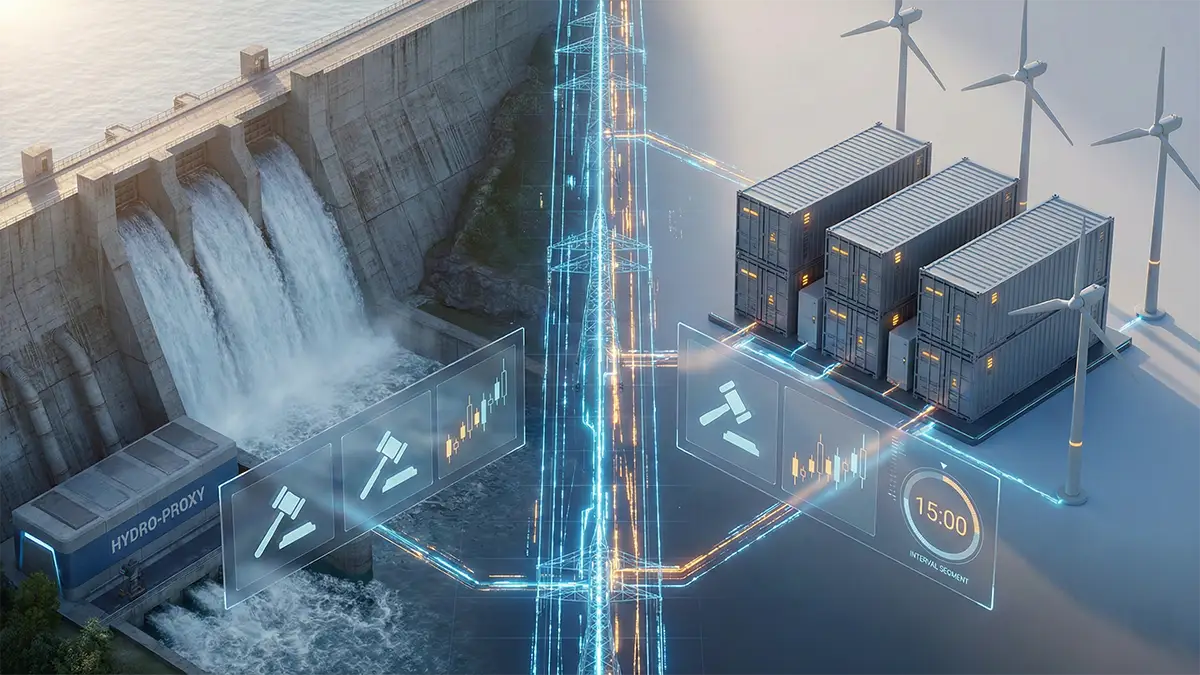
The year 2026 marks a pivotal shift for the Serbian energy sector, replacing previous administrative methods with transparent auction processes for the procurement of ancillary services
Understanding the new Market Rules, pricing mechanisms for ancillary services, and the role of dominant participants is becoming a prerequisite for survival in the electricity market
The fundamental parameters for the procurement of ancillary services (balancing capacity) in Serbia for 2026 are explained below.
- Quantification of Needs and the Auction Model
EMS (the Transmission System Operator) has defined precise quotas for balancing reserves in 2026. Procurement will be conducted exclusively through quarterly and daily auctions, requiring precise availability forecasting from all participants (BSPs – Balancing Service Providers).
The defined volumes for 2026 are:
- FCR (Frequency Containment Reserve): 42 MW (symmetric – for both upward and downward directions).
- aFRR (Automatic Frequency Restoration Reserve): 80 MW (symmetric – for both upward and downward directions).
- mFRR (Manual Frequency Restoration Reserve): 300 MW for the upward direction and 135 MW for the downward direction.
A key structural change is the introduction of marginal pricing (pay-as-cleared) for the settlement of activated balancing energy, effective from April 1, 2026. Until that date, the pay-as-bid model will apply.
Under the pay-as-bid model, each participant receives exactly what they requested in their bid. The introduction of marginal pricing (pay-as-cleared) implies that all successful bidders in the auction receive the same price – the price offered by the most expensive accepted bidder (the so-called marginal bidder).
This alignment with European practice (EBGL) will encourage participants to bid their actual marginal costs, eliminating the need to speculate on risk when setting their offered price.
- Economic Parameters: Capacity Reservation and Opportunity Costs
One of the most important aspects of the new framework is the maximum price for capacity payments.
EMS has established these prices based on opportunity costs, using optimization models of hydroelectric plants – HPP Đerdap 1 (Iron Gate 1) for aFRR and RHPP Bajina Bašta for mFRR:
- Price Caps for aFRR in 2026: Range from 5.13 – 20.96 €/MW/h.
- Price Caps for mFRR in 2026: Range from 0.9 – 5.33 €/MW/h.
Although the technical system need for FCR is 42 MW, the maximum reservation price is limited to 0 €/MW/h. This is because primary regulation is treated as a mandatory technical standard and a prerequisite for connection, rather than a commercial service for which a readiness fee is paid.
It is estimated that the total costs for capacity reservation (aFRR + mFRR) in 2026 could reach up to 31 million euros, with the caveat that competition in auctions will likely result in lower final costs.
- The Dominant Participant and the “25 MWh Rule”
The new market framework recognizes the specific position of EPS as a dominant participant (controlling >40% of installed capacity). To prevent market distortion, strict bidding rules have been introduced; EPS must submit a single aggregated bid for all its resources, rather than individually by unit.
Additionally, a price limit (25 MWh) has been introduced. For the first 25 MWh of regulation (upward or downward), the price is firmly tied to the Day-Ahead Market (DAM) price. For example, for the upward direction, the price cannot exceed the DAM price plus 30 €/MWh or 40% of the absolute value of the DAM price (whichever is higher). This serves as a system protection mechanism against extreme prices in zones of shallow market liquidity.
- Demand Response: A New Model of Flexibility
Legislation and market rules now explicitly recognize manageable consumption as a resource. In the context of balancing, downward regulation for Demand Response (DR) implies an increase in consumption at the operator’s request.
Aggregators and industrial consumers can participate in aFRR and mFRR auctions on equal footing with producers. For instance, if a cold storage facility offers to increase consumption to absorb excess wind or solar energy, it will be paid for that readiness (reservation) under the same market principles as a pumped storage hydroelectric plant.
- 15-Minute Settlement
As of January 1, 2025, the settlement interval is fixed at 15 minutes. This is a fundamental requirement for Balancing Responsible Parties (BRPs). Imbalance prices and activated energy prices will be calculated for each quarter-hour, with a hard cap on imbalance prices at 15,000 €/MWh, or up to 1.5 times the cost of activated energy in the given interval.
Impact on the Development of Battery Systems
Despite the opening of the ancillary services market, the 2026 model presents significant structural and economic barriers for Battery Energy Storage Systems (BESS). Economic signals in 2026 are not favorable for standalone batteries; instead, they favor existing hydro capacities.
- The “FCR = 0 €” Obstacle
The biggest challenge for standalone battery projects in 2026 is the decision to cap the reservation price for FCR (primary reserve) at 0 €/MW/h. In developed EU markets, FCR is a main revenue stream for batteries due to their fast reaction and low energy content. Batteries dominate this segment elsewhere.
By removing revenue from capacity reservation for FCR, BESS investors lose their most secure revenue stream. Batteries would have to rely exclusively on arbitrage or other types of reserves, drastically increasing investment risk.
- aFRR and “Hydro-Proxy” Price Capping
EMS has capped reservation prices for aFRR (secondary reserve) based on the opportunity cost of hydroelectric plants (HPP Đerdap). The projected maximum is relatively low for new battery projects, which have high capital expenditures (CAPEX) compared to amortized hydro plants.
For a standalone battery system to be profitable solely through aFRR within this framework, it must be exceptionally efficient and combined with an aggressive strategy on the intraday market.
- Opportunities for BESS: 15-Minute Fluctuations and Arbitrage
The introduction of the 15-minute settlement interval and the shift to marginal pricing (pay-as-cleared) from April 2026 may be one of the main drivers for battery systems.
Batteries can exploit price differences within the day (Intraday), buying cheap when solar is generating at full capacity and selling high during evening peaks. With imbalance penalties theoretically reaching up to 15,000 €/MWh (or 1.5x energy price), the value of a battery lies not only in selling services to EMS but in reducing imbalance costs for RES plant owners.
- Hybridization as the Dominant Model
Due to the aforementioned limitations (low capacity prices), 2026 will not see a boom in large, standalone batteries connected to the transmission grid solely for balancing. Instead, the market will encourage co-location (hybrids).
Wind and solar investors will integrate batteries (e.g., with a capacity equal to 20% of the plant’s power) to optimize their production profiles and avoid high imbalance penalties. Here, the battery serves as an “insurance policy.”
- Technical Advantage of BESS in aFRR
Although the price is capped, battery systems hold a technical advantage over hydroelectric plants in terms of response speed.
If EMS introduces stricter requirements for regulated quality or faster-response products in the future (e.g., FFR – Fast Frequency Response), batteries will become essential, as hydroelectric units face mechanical limitations and wear-and-tear costs due to constant regime changes.
Conclusion
For investors in renewable energy sources, the opening of the ancillary services market in Serbia means that the value of flexibility (especially aFRR and mFRR) can now be more precisely quantified through transparent auctions.
The market in 2026 will not automatically trigger a “gold rush” for battery systems due to conservatively set price limits based on hydrology. However, its opening provides an opportunity to develop business models based on Value Stacking:
- Participation in aFRR and mFRR auctions (taking what is available).
- Aggressive arbitrage on the 15-minute Intraday market.
- Internal balancing of RES power plants.
Investors considering BESS should focus on financial models that do not rely primarily on capacity payments, but rather on energy arbitrage and imbalance savings. Standalone battery projects are risky—projects co-located with RES plants represent the most favorable variant in the current model.