
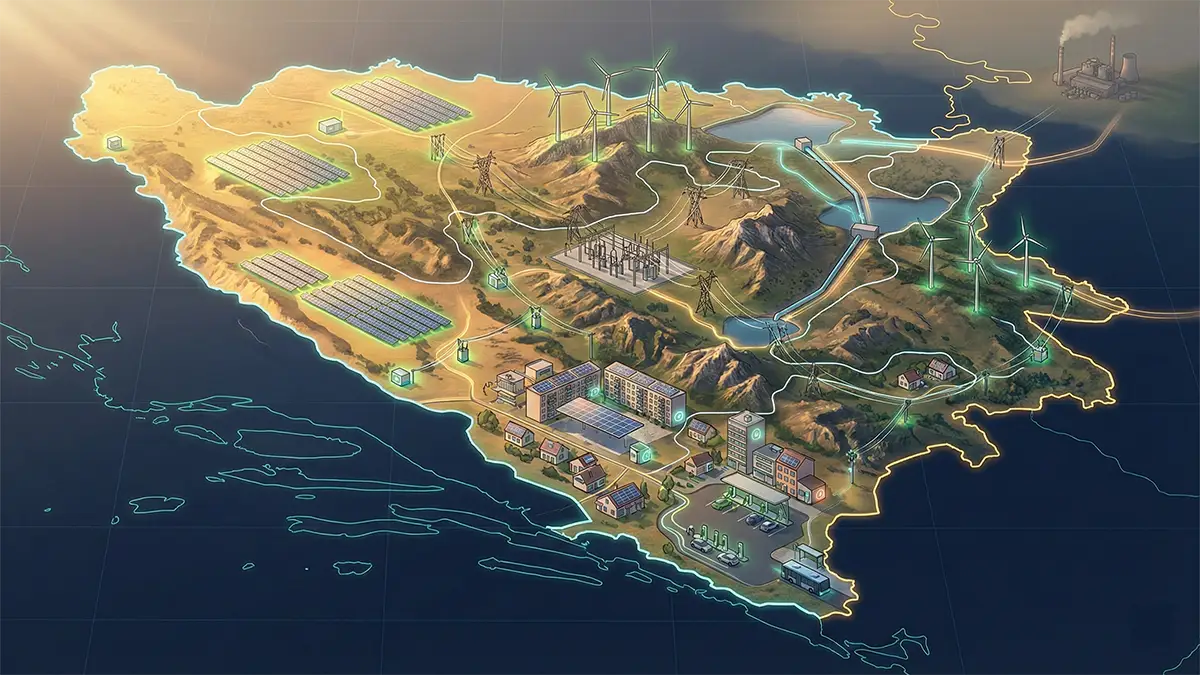
By 2030, Bosnia and Herzegovina plans to make much more electricity from the sun and wind. The National Energy and Climate Plan (NECP) sets out this change. New solar plants of about one and a half gigawatts (GW; billions of watts) and new wind plants of about six hundred megawatts (MW; millions of watts) are expected. Hydropower stays important, and a large pumped-hydro storage plant will act like a giant water battery that stores energy when it is cheap and releases it when it is needed.
What’s in the pipeline
- New capacity focus: ~1.5 GW solar PV and ~600 MW wind added by 2030, on top of a strong hydro base.
- System stability: ~420 MW of pumped-hydro storage (PHS) as the anchor for flexibility.
- Electrified heat: a 100 ktoe target for heat pumps (residential/public buildings and large HPs for district heating/cooling).
- Grids: a decade-scale distribution investment program (MV/LV reinforcements, 10→20 kV conversions) plus transmission reinforcements and cross-border capacity.
- Transport: a renewable energy in transport (RES-T) target drives cleaner mobility; EV measures are in place, but without a hard 2030 EV/charger count.
The plan also talks about cleaner heating. Heat pumps, which move heat instead of burning fuel, are expected to deliver around one hundred kilotonnes of oil equivalent (ktoe) by 2030. This would help homes and public buildings use less coal and gas, especially in winter.
To connect all these new sources, the country must upgrade its power grids. The transmission system operator (TSO), the company that runs the highest-voltage lines, will reinforce 400-kilovolt lines and improve links to neighboring countries, allowing electricity to move easily across borders. The distribution system operators (DSOs), the companies that manage local power lines, will strengthen medium- and low-voltage networks, reduce losses, and complete the step from 10 kV to 20 kV where necessary. These upgrades make space for rooftop solar panels, small batteries, electric-vehicle chargers, and future digital tools.
Households, small businesses, towns, and housing associations are encouraged to become “prosumers,” which means they both produce and use electricity, typically with rooftop solar photovoltaic panels (PVs). Energy communities, where neighbors plan and share projects, are also supported by new rules. Easier permits and early grid checks should help these projects move from plans to real installations.
Transport will get cleaner as well. The country sets a goal for more renewable energy in transport (RES-T). Tax and customs rules will make electric vehicles (EVs) easier to purchase, and a legal framework will support the establishment of new charging stations. The plan does not specify a fixed number of EVs or chargers for 2030, but the amount of electricity set aside for road transport suggests a steady increase in both.
Coal will go down step by step. No new coal units are planned, and older units are expected to start retiring after 2028. There is no single “exit year,” but the direction is clear. To keep the lights on while coal declines, the country will rely on pumped-hydro storage, improved cross-border lines, and the growth of solar and wind energy.
There are a few gaps that need attention. The plan does not establish a national target for smart meters, which are part of the advanced metering infrastructure (AMI), comprising digital meters that record detailed electricity use and enable modern tariffs. Without a clear AMI plan, digital readiness may differ from one DSO to another. The plan is also cautious on exact counts for EVs and public chargers, so cities will need to lead with their own mobility plans.
In short, Bosnia and Herzegovina’s path to 2030 is to build a lot of solar and wind, anchor the system with pumped-hydro storage, clean up heating with heat pumps, and modernize both transmission and distribution grids. If public bodies, utilities, and investors act quickly and work together, the country can deliver cleaner electricity, better reliability, and lower pollution while keeping power affordable.