
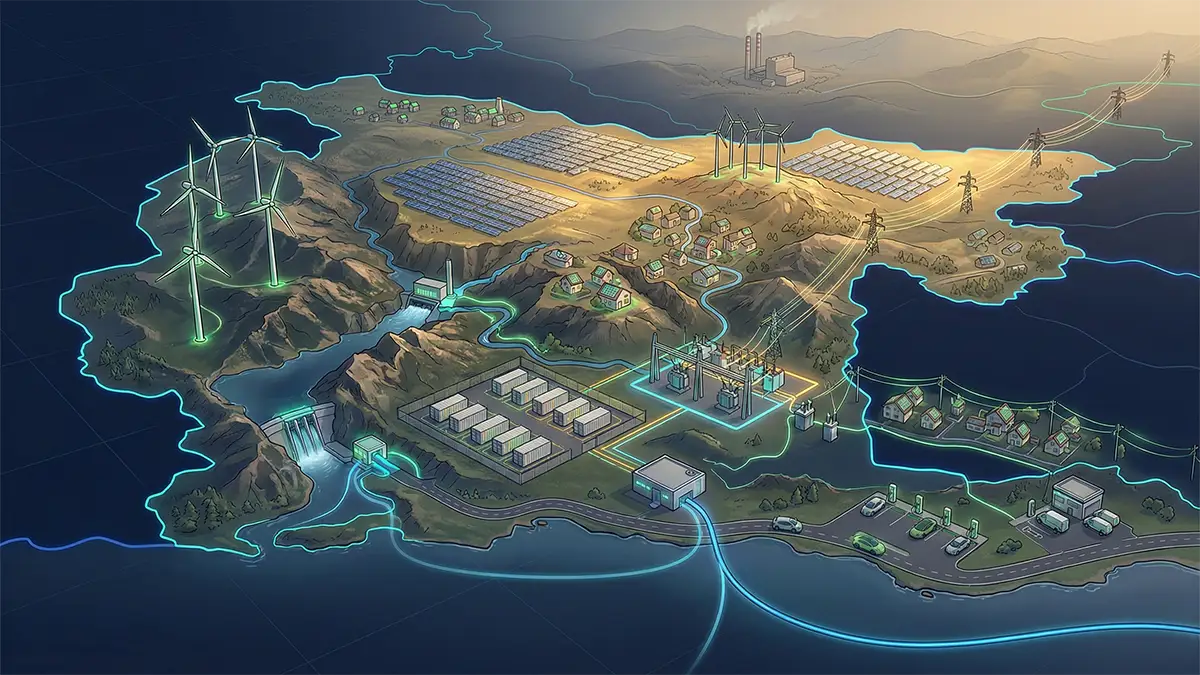
Montenegro’s draft National Energy and Climate Plan (NECP) is a study in pragmatic ambition. It pushes hardest where the state and network companies can deliver—grids, dispatch, and market integration—and keeps a lighter touch where consumer behavior drives outcomes.
What’s in the pipeline
- Hydropower: HE Komarnica (~172 MW) and Kruševo (~82 MW) anchor firm renewable capacity.
- Wind: Gvozd I & II plus ~200 MW additional onshore wind in the “with-measures” scenario.
- Solar: Named utility projects (Briska Gora, Velje Brdo, Tuzi, Vilusi, Krupac, floating PV) and a large rooftop/prosumer wave.
New power plants will add clean electricity. Two hydropower projects, Komarnica with a capacity of approximately 172 MW and Kruševo with a capacity of roughly 82 MW, provide steady renewable energy. Onshore wind grows through the Gvozd projects and other sites, adding approximately 200 MW in the scenario with measures. Utility-scale solar farms are planned for several locations, and many homes and businesses are expected to install rooftop solar photovoltaic systems (PV).
The electrification of heating will advance primarily through building renovations. The plan anticipates that resistance heaters will be replaced by heat pumps following deep retrofits; however, it does not establish a numeric target for heat pumps or the share of electrified heat by sector for 2030. This approach keeps things practical but leaves room for clearer goals later.
Prosumers – individuals or companies that both produce and consume electricity – are already participating. More than 26,000 customers have expressed interest, and approximately 70 MW of capacity is currently connected. A budget of €130 million is foreseen between 2025 and 2030 to support rooftop PV for households, as well as commercial and industrial users. Even small systems of 5 to 7 kW per site can add up to tens of MW by 2030, and higher uptake could exceed 100 MW. This growth requires meter changes, local grid upgrades, and retail tariffs that reward smart use.
Energy communities, where neighbors plan and share energy projects together, are mentioned but do not yet have targets or a dedicated support scheme. Given Montenegro’s size and geography, this is a gap that future policy can fill.
Electricity storage will be guided by rules rather than fixed numbers. The plan sets no specific target for battery energy storage systems (BESS). Instead, it will require storage with new renewable plants where the system needs it, with the size defined in the grid code or a by-law. This flexible approach ties storage to real operational needs.
The transmission grid, the high-voltage network operated by the transmission system operator (TSO), aims to keep losses at around 2% even as flows increase. The control room will incorporate modern digital tools, including SCADA/EMS (Supervisory Control and Data Acquisition/Energy Management System), WAMS (Wide-Area Monitoring System), and secure communications based on IP/MPLS (Internet Protocol/Multiprotocol Label Switching). Key projects include the 400 kV corridor from Brezna to Crkvičko Polje, which extends toward Sarajevo, as well as links that support the Trans-Balkan Corridor. Additionally, there is a stronger emphasis on utilizing the high-voltage direct current (HVDC) cable to Italy. These steps prepare Montenegro for day-ahead and later intraday market coupling, starting with Italy.
The distribution grid, which is the medium- and low-voltage network operated by distribution system operators (DSOs), aims to reduce losses to below 10% by 2030. Plans include transitioning to a 110/10 kV structure, adding complete remote control to new or rebuilt substations, and deploying a DMS/OMS (Distribution Management System/Outage Management System) with SAIDI and SAIFI tracking (standard measures of outage duration and frequency). Advanced metering will expand through AMI/AMR (Advanced Metering Infrastructure/Automatic Meter Reading), and the low- and medium-voltage networks will be reinforced to accommodate more rooftop PV and charging for electric vehicles (EVs).
Smart meters will be encouraged, but the plan does not set a specific share for 2030. The policy is to make smart metering a general practice, enabling it to reduce losses, facilitate demand-side management, and support time-of-use or dynamic tariffs. A national target would make progress easier to track and measure.
Electric mobility is promoted, but there is no fixed target for the share of EVs or the number of public chargers. Growth will likely begin along tourist corridors, in coastal hubs, and at fleet depots. The speed of rollout will depend more on tariff design and simple permitting than on subsidies alone, and DSOs will need to prepare local grids for clustered charging.
Coal’s role will fall over time. In the ambitious pathway, the Pljevlja plant is expected to provide approximately 27.5 percent of the generation in 2030, with reduced operating hours as renewable energy sources and interconnections expand. After 2040, the plant is expected to serve mainly as a cold reserve.
The main risks are the lack of clear numbers for heat pumps, EVs, and smart meters, which makes progress harder to measure. Still, the direction is firm.
By 2030, Montenegro expects to increase its renewable energy sources, strengthen its grid, reduce technical losses, and decrease its reliance on coal. With the HVDC link to Italy, a future 400 kilovolt corridor to Bosnia and Herzegovina and Serbia, and advanced TSO tools, the country is designing a grid that can trade and balance power reliably across borders while keeping electricity clean and affordable.