
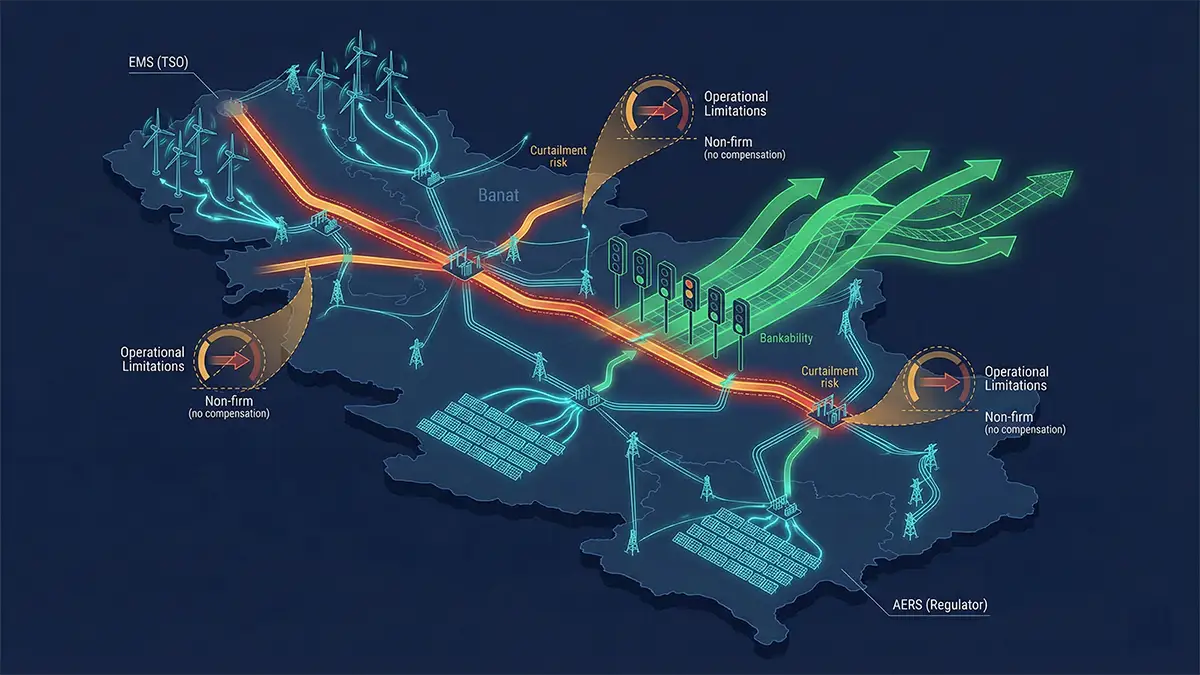
As Serbia races to connect new wind and solar (vRE), the transmission grid is feeling the strain. To keep the system safe, the country increasingly uses operational limitations—temporary caps on active power at the connection point—when granting non-firm grid connections. These limits are proposed by the TSO (EMS) and approved by the regulator (AERS) on a case-by-case basis to ensure transparency and prevent discrimination.
Serbia’s approach protects fairness and transparency during the vRE connections — but it risks becoming its own bottleneck. AERS can keep the guardrails while exchanging the traffic light by traffic light model for a green-wave framework: standardized, digital, transparent — and investor-friendly.
Two things are true at once: the model is legally robust and aligned with EU rules that allow conditional connections when transparent and regulator-approved; yet it is increasingly inefficient and risky for investors because every limitation needs an individual AERS decision and curtailment inside the non-firm envelope is not compensated.
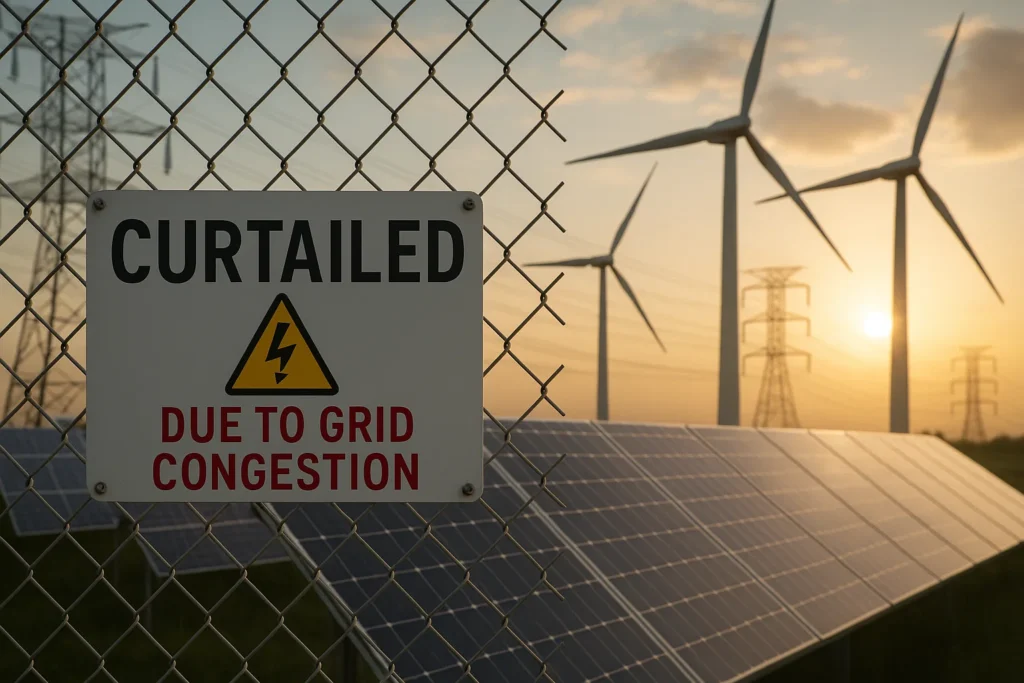
Compared with EU peers, Serbia’s combination—uncompensated non-firm limits + per-project regulatory approvals—ensures compliance but creates an administrative bottleneck and shifts curtailment risk to developers.
What “Operational Limitations” Mean in Practice
When EMS studies a connection, it identifies grid elements at risk (e.g., a constrained 220 kV corridor) and sets the operating conditions that would cap output:
- Some limits apply until reinforcements are commissioned.
- Others persist when topology changes keep the electrical path constrained.
- At cross-border nodes, limits may reflect agreed transfer capacities with neighbors.
Under Serbia’s Energy Law and rulebooks, these limits are temporary reductions at the connection point. AERS must decide within 15 days, and connection offers can be issued with limited power, conditional works, or operational limitations—but no compensation is paid if a developer accepts a non-firm offer.
Why Investors Care: Bankability Effects
Uncompensated curtailment inside the accepted non-firm envelope makes annual energy uncertain. That uncertainty:
- Pushes lenders to raise risk premiums and tighten DSCR assumptions.
- Complicates PPA pricing and revenue forecasts.
- Slows deal flow and raises the cost of capital, especially because limits are bespoke and approved case-by-case rather than standardized.
How EU Peers Handle Curtailment and Access
- Germany: Firm connections; congestion handled via Redispatch 2.0 with balancing correction and financial compensation for curtailed energy.
- France: Firm connections; the TSO can limit output under a regulator-approved Transmission Access Contract, with compensation for curtailment.
- Greece: Non-firm connections exist, but within standardized frameworks and regulator-approved caps (often ≤5% annual loss). Within the cap, no compensation; rules are pre-defined, not bespoke.
- Croatia: No standing ex-ante limits; curtailment is settled and compensated under congestion rules, typically in 15-minute intervals.
- Slovenia: Law defines “flexible operational limitations.” Within the accepted envelope, no compensation; beyond it, EU Article 13 compensation applies.
Bottom line: EU practice tends to either compensate curtailment or apply standardized, regulator-approved caps and methods—not bespoke, uncompensated limits reviewed one by one.
What Serbia Can Do Next: From Case-by-Case to Pre-Approved Categories
Instead of per-project approvals, Serbia can adopt AERS-pre-approved categories of operational limitations. This preserves transparency and non-discrimination while improving predictability and bankability.
- Static output caps (e.g., PV at 90% in summer; wind at 85% in high-congestion zones).
- Seasonal/time-of-day profiles (e.g., PV at 70% from 11:00–15:00 in summer).
- Dynamic curtailment windows (e.g., up to 20% reduction if an N-1 breach is forecast on a 220 kV corridor).
- Technology-specific rules (e.g., storage-hybrids exempt from static caps if able to absorb ≥20% of peak).
- Geographically defined zones with aggregate injection ceilings.
- Temporary bridging limits that sunset when reinforcements are commissioned.
FAQs
What’s a non-firm connection?
A grid connection that allows output to be limited under certain conditions to protect the system — usually without compensation inside the agreed envelope.
Why not just build more grid?
Reinforcements take time and money; non-firm connections can unlock capacity faster, but they need clear, standardized rules to avoid scaring off investment.
Who decides limits today?
EMS proposes them; AERS approves each case within 15 days (statutory), checking transparency and non-discrimination.